
Our know-how:
the drive for
your projects.
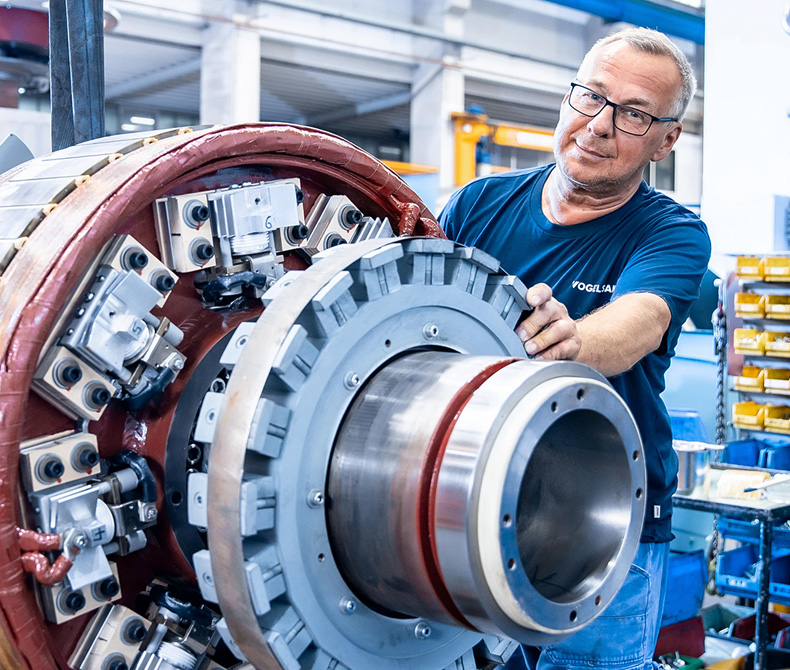
Our know-how: the drive for your projects
Our specialists have decades of experience in the repair of electric motors in a wide variety of industries and locations. No matter what the challenge is: we are at your service.
Our services at a glance:
In the workshop:
- Maintenance, repair and overhaul of motors
- Reengineering and production of spare components and of complete machines
- Mechanical adaptation of machines
- Production of high voltage windings in resin rich and VPI technology
- Production of roebel bar windings
- Production of DC windings for stators and rotors
- Commutator repairs, new delivery and reconstruction
- Production of round wire windings also in inverter-proof design
- Re-stacking of stators and rotors
- Renewal of rotor windings (short-circuit windings of asynchronous motors and pole coils for synchronous machines)
- Repair of Ex-protected motors
- Load and acceptance tests on modern, computer-aided test rigs
On site:
- Disassembly and assembly, maintenance and inspection work
- On-Site-Balancing
- Roller bearing analyses and electrical analyses
- Laser alignment of machine trains
- Measurement and evaluation of machine vibrations with frequency analyses
- Thermographic and endoscopic examinations
- Flatness and machine-foundation surveys
- Efficiency tests of complete machines according to patented methods
- Dissipation factor measurement (tan delta) and partial discharge measurement (PD) on high-voltage windings
- On-site commutator machining with mobile turning devices
- Consulting for and support of maintenance projects
- Introduction of condition-based maintenance
- Efficiency analyses on complete machine sets
Important questions about the repair of electric motors
When is rewinding an electric motor more sensible than a partial repair?
Whether rewinding is necessary is not determined solely by the visible damage. We consider the condition of the winding insulation, the type and extent of any electrical or thermal damage, the condition of the laminated core, and future operating conditions. If damaged areas can be reliably contained, a partial repair may suffice. However, in cases of extensively aged or damaged insulation, rewinding is often the more robust solution.
How do we assess the condition of a high-voltage winding?
We combine several testing and measurement methods into a comprehensive assessment. This can include insulation and resistance measurements, dissipation factor measurements, partial discharge measurements, as well as thermographic or endoscopic examinations. The decisive factor is not a single measurement, but the interplay of measurement data, trend, design, operating history, and visible condition. From this, we determine whether continued operation, targeted repair, or rewinding is advisable.
What tests show whether a repaired electric motor is safe to operate again?
The scope of testing depends on the motor, the type of damage, and the agreed-upon acceptance criteria. We check the relevant electrical and mechanical parameters and, depending on the machine, perform functional, idle, load, or acceptance tests. These tests include checking current draw, temperature behavior, vibrations, and stable operation. The results are compared with the defined target or acceptance criteria and documented in a traceable manner.
What special features do we need to consider when using an inverter-fed electric motor?
In inverter operation, steep voltage pulses, harmonics, bearing currents, and reduced self-cooling at low speeds can place additional stress on the motor. Therefore, we consider winding insulation, bearings, cooling, cables, filters, and inverter parameterization as an integrated drive system. From this, we determine whether an inverter-compatible winding or other protective measures are required.
What information do we need for the initial technical assessment of a damaged electric motor?
For an initial assessment, we need the nameplate data, design, power, voltage, speed, operating mode, and as precise a description of the problem as possible. Measurement data, photos, fault logs, load information, and the repair history help to narrow down possible causes and determine the next step in the investigation. We also clarify the installation situation, accessibility, and the available downtime window.
How do load profile and environmental conditions influence the repair concept of an electric motor?
Continuous operation, frequent starts, overloads, dust, humidity, aggressive media, or high ambient temperatures can place varying stresses on windings, bearings, and cooling systems. We incorporate these conditions into our material selection, insulation, sealing, cooling concept, and testing program. This ensures that the machine is not only repaired but also evaluated for its actual operating conditions.
You have questions? Perfect!
Are you planning a specific project and need individual advice? Would you like to learn more about our services? Simply fill out our form or give us a call. We look forward to hearing from you.