
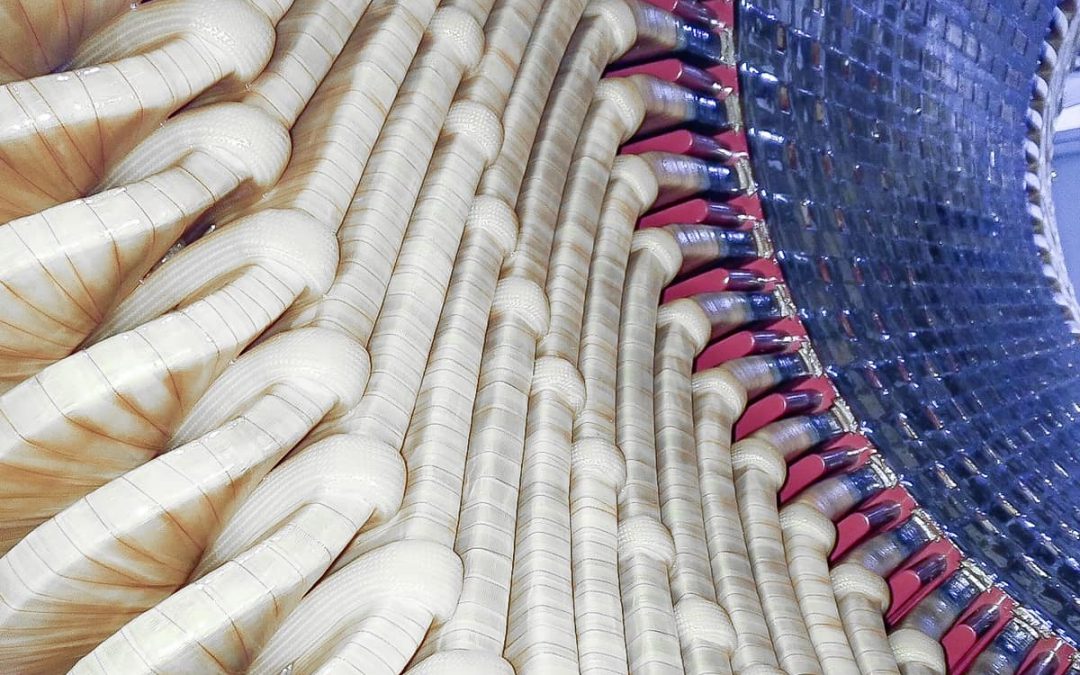
The manufacture of coils for high-voltage machines is a process that appears very simple at first glance but requires great care in both production and the selection of materials and machinery. In the manufacture of high-voltage windings, Vogelsang relies—as much as possible—on the VPI process, which differs from the resin-rich process in many respects. There are numerous, often highly technical papers that address the differences between the two technologies. Here, we will limit ourselves to the basics and invite all interested readers to join the discussion with us.
VPI and Resin-Rich: Two Different Insulation Systems
The main difference between the technologies lies in the design and manufacture of the coils’ actual insulation system. While the insulation system in the VPI process is not completed until after the winding has been impregnated and cured in a convection oven, the leg of the resin-rich coil—which is cured separately under temperature and pressure—already constitutes a functional and testable insulation system even before it is installed in the stator.
The VPI process uses porous tapes that are impregnated with resin under vacuum and then subjected to positive pressure in the impregnation tank. After curing in a convection oven, this results in a solid and continuous insulation system. The advantages of this technology lie, on the one hand, in its lower-cost mass production and, on the other hand, in the particularly high hardness of the coil—even within the winding head. The resulting winding is highly resistant to electromagnetically induced mechanical forces within the winding head and is expected to have a service life of over 25 years.
VPI Method: Process Quality and Testing Procedures
In our manufacturing process, we rely on an insulation system that has been certified by the PTB. This coordinated insulation system forms the basis for a high-quality high-voltage winding—though it’s only “half the battle.”
The parameters of the drying and impregnation process, the winding itself, and the subsequent curing of the winding in the oven—using a continuous process whenever possible—ultimately determine the quality of the winding. This quality can be verified through Tan Delta measurements, partial discharge measurements, and ISO measurements. For the past three years, we have also expanded the impregnation process to include a capacitance measurement, which allows us to monitor and document the complete penetration of the insulation system with resin during the impregnation process.
Resin-Rich: Benefits and Applications
In contrast, the production of resin-rich coils is more complex, as each coil leg must be manufactured individually in special baking presses. This results in higher production costs per coil. A major advantage of the resin-rich coil is that the quality of the coils can be tested before they are installed in the stator. This provides additional reliability in the manufacturing process. For some machines, however, resin-rich winding is the only option, as the motors are too large to fit into the VPI impregnation system. Here, we are technically limited to a diameter of 3.5 meters and a unit weight of just under 30 metric tons. Another advantage is the ability to perform a partial repair of the winding using so-called “prostheses” in the event of a subsequent coil failure. This involves replacing individual coil legs. Depending on the installation situation and the duration of a potentially necessary complete overhaul, this option certainly represents a viable alternative to a complete rewinding for production purposes. For rewinding on-site at the machine’s location, the resin-rich coil is actually the only option, as it does not require vacuum impregnation.
Conclusion: Two approaches with different strengths
When the appropriate manufacturing technology is used, both insulation systems are absolutely comparable in terms of quality. However, there are design constraints that prevent a switch between the technologies. Due to its cost advantage in mass production, the VPI process has become increasingly important in the field of new production.