
Reengineering,
adaptation or new delivery?
We do!
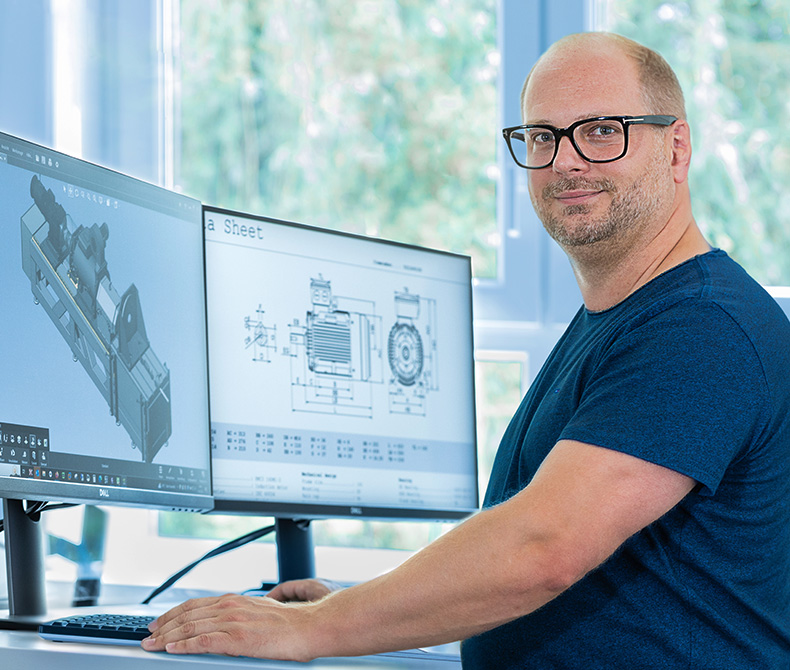
New machine construction, Reconstruction or new delivery? We do!
Our services at a glance:
- Engineering and design of motors and generators
- Complete service from engineering and project planning to commissioning
- Brand-neutral advice on machine rebuilds and new purchases
- Design and supply of diesel gensets
- Mechanical adaptations and special designs
- Acceptance of machines for potentially explosive atmospheres at our own test facilities
Reengineering and new delivery of:
- Standard and transnorm asynchronous motors in low voltage and medium voltage
- explosion-proof motors for equipment categories I, II and III
- DC motors and their components
- Frequency converters
- Transformers
- Pumps and pumping equipment
- Fans
Important Questions About Re-Engineering, Replication, and Redelivery
Is it possible to re-engineer an electric machine without complete drawings?
We determine whether re-engineering is possible without complete drawings by examining the accessible machine and the available operating data. Existing components and interfaces can be measured and technically documented. In doing so, we must distinguish between the original design, wear and tear resulting from operation, and subsequent modifications. Missing information or details that cannot be clearly reconstructed may limit the feasibility of the project and the ability to provide verification. For this reason, we assess the specific initial condition before committing to a replica.
When do we recommend a replica, a modification, or a new delivery?
A replica may be a good option if an existing electric machine is no longer available and the installation space and interfaces must be largely preserved. A retrofit is an option if operating conditions or requirements have changed and suitable components can be reused. A new machine is often the better solution if an available machine reliably meets the requirements or if the effort required to adapt a replica would be too high. We compare the options based on technical feasibility, retrofitting costs, delivery time, operational risk, and expected service life.
How do we take changing efficiency and operational requirements into account when building a replica?
We do not automatically replicate the historical configuration; instead, we evaluate the current load profile, the desired efficiency, inverter operation, cooling, insulation, protection class, and mechanical interfaces. Changes in standards and operational requirements are also taken into account on a project-by-project basis. This results in a solution that fits into the existing system while also meeting current operational goals. The planned testing and acceptance criteria are established early on.
How do we determine whether a new electric machine will fit into the existing system?
We define the mechanical, electrical, and system-related interfaces, as well as the required performance data, in advance. This includes, for example, dimensions, shaft and mounting dimensions, connection data, direction of rotation, cooling, and the intended operating conditions. Dimensional inspections, documentation, and agreed-upon functional or load tests then serve as verification. Which tests are possible and required depends on the machine, its performance, and the agreed-upon test program.
What is the process for a project, from design to commissioning?
We begin by identifying the technical requirements, the existing interfaces, and the desired operational behavior. This is followed by the conceptual design, calculation, and sizing of the electric machine, as well as the coordination of the design, scope of delivery, and test program. After manufacturing or procurement, the agreed-upon inspections and tests are performed and documented. Depending on the order, we then also provide support for installation and commissioning. The exact process depends on the machine type, project scope, and on-site conditions.
You have questions? Perfect!
Are you planning a specific project and need individual advice? Would you like to learn more about our services? Simply fill out our form or give us a call. We look forward to hearing from you.