
We keep your
transformers
running.
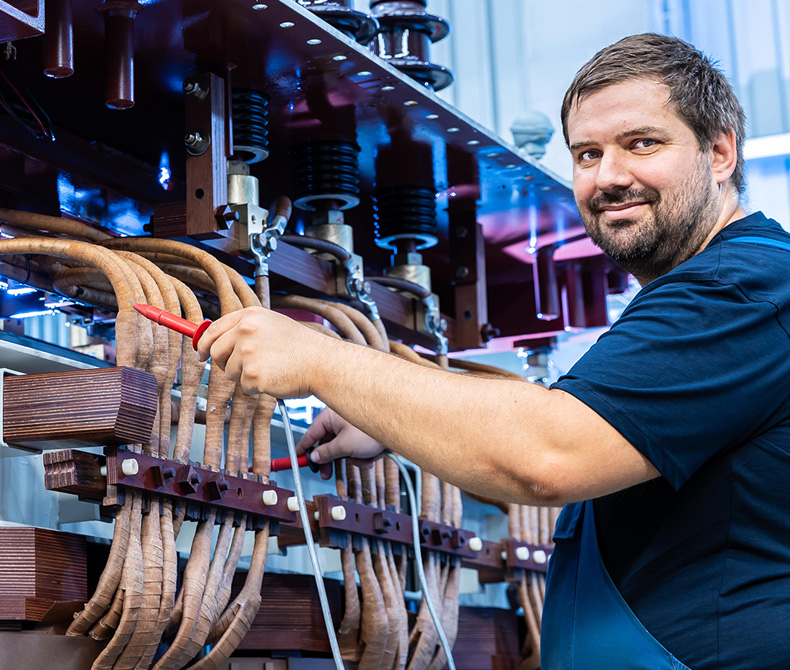
We keep your transformers running.
Our services at a glance:
In the workshop:
- Repair and overhaul of transformers
(on the high voltage side up to 110 kV or up to 100 MVA, active part weight up to 100 t) - New windings of coils, coil blocks and partial coils
- Vacuum drying of active parts and refilling with regenerated or new oil under vacuum
- Preparation, regeneration as well as replacement of used insulating oils with environmentally friendly recycling
- Final testing according to VDE/IEC or customer specifications
- Revision of on-load tap-changers and loadless tap-changers
- Repair and reconstruction of transformer housings and bushings
On site:
- Repairs and revisions on all types of transformers (all manufacturers)
- Mobile vacuum microfiltration for 1,000 l/h, 4,000 l/h and 9,000 l/h with different hose sets
- Regeneration of insulating oils by means of the fuller's earth process
- Mobile oil conditioning units for temporary use
- Operating oil analyses, gas-in-oil analyses and furan analyses
- Replacement of feedthroughs and conversion to alternative feedthrough systems
- Conventional sealing work and conversion to alternative sealing systems
- Environmentally friendly refilling of oil transformers
- Tests according to VDE as well as partial discharge measurements
Important questions about transformer repair
What can gas-in-oil and furan analyses tell us about a transformer?
Gas-in-oil analyses can provide indications of thermal or electrical abnormalities in the active component. Furan analyses support the assessment of the aging of cellulose-based insulating materials. We do not evaluate the results in isolation, but rather in conjunction with comparative values, operating history, load, and other tests. Only this comprehensive view allows for a reliable recommendation regarding monitoring, maintenance, or overhaul.
When is regenerating the insulating oil advisable and when is it insufficient?
Oil regeneration can be beneficial if the insulating oil's properties can be improved and there is no further damage to the transformer that would preclude it. However, it does not replace repairs to the windings, active components, bushings, or sealing systems. Therefore, we examine the oil condition, analyze the results, check the moisture content, assess the age of the oil, and determine the suspected cause of the damage. This assessment determines whether conditioning, regeneration, replacement, or a more extensive overhaul is necessary.
What transformer work can be carried out on site and when is a factory overhaul required?
Depending on the findings, on-site services can include testing, oil treatment, sealing work, replacement of bushings, and certain overhauls. A factory overhaul is required if extensive disassembly, rewinding, vacuum drying, or work on the active component under controlled workshop conditions is necessary. We determine the appropriate course of action based on the damage pattern, transportability, safety requirements, and the necessary testing equipment.
How do we demonstrate operational safety after a transformer repair?
The scope of testing depends on the design, the extent of the repair, and agreed-upon VDE, IEC, or customer specifications. Depending on the order, we test, for example, insulation and winding resistances, gear ratios, oil condition, or partial discharge behavior. The results are compared with defined criteria and existing reference values. This creates a verifiable acceptance certificate for the work performed.
When is it more worthwhile to repair a transformer than to replace it?
We compare the condition of the active components, windings, insulation, tank, bushings, and switching components with the repair costs, failure risk, and expected remaining service life. Delivery time, replacement availability, and the transformer's importance to operations are equally important. Repair is worthwhile if the structural integrity is sound and the result is economically viable.
When is a partial discharge measurement useful on a transformer?
Partial discharge measurement can be useful if local electrical activity is suspected in or on the insulation, or if a defined condition or acceptance test is required. The measurement setup, interference level, and operating condition influence the results. We therefore evaluate the results in conjunction with the design, history, and other electrical or oil-related tests.
You have questions? Perfect!
Are you planning a specific project and need individual advice? Would you like to learn more about our services? Simply fill out our form or give us a call. We look forward to hearing from you.