
Full Service
for your pumps!
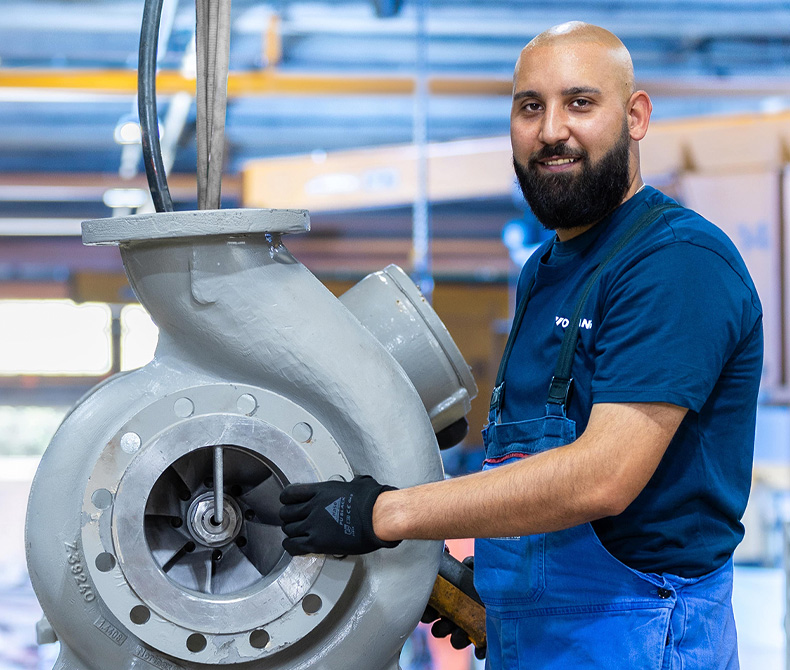
Full service for your pumps!
Our services at a glance:
In the workshop:
- Manufacturer-independent repair of submersible pumps, standard centrifugal pumps, compressors, borehole pumps, special and custom pumps as well as canned motor and slurry pumps
- Spare parts and new delivery of pumps
- Pump testing on our own test rigs (connected loads up to 300 kW, hydraulic pumps up to 40 bar/DN 300)
- Acceptance testing of Ex-proof pumps
- Steel and plant construction with own construction and prefabrication of pipelines
- Construction of new pumping stations for waste- and floodwater management
On site:
- Manufacturer-independent pump maintenance and repair (types see above)
- Spare parts and new delivery of pumps
- Inspection of control, switching and safety devices
- Measurement of electrical values, flow rates and wall thickness measurements
- Pump assembly and disassembly (also for aggressive media incl. environmentally friendly disposal of residual media)
- Analysis and optimization of existing pumping systems (including efficiency analysis, comparison of target/actual characteristic curve)
Important questions about pump repair
When is it more worthwhile to repair an industrial pump than to buy a new one?
Repair is often worthwhile if the housing and essential components can be reused, spare parts are available or can be reproduced, and the pump subsequently operates reliably at the required operating point. We compare the extent of the damage, repair costs, delivery time, energy consumption, and expected remaining service life. If a repair is not technically or economically feasible, we consider a replacement or modification of the pump system.
Why does a pump no longer reach its original flow rate or pressure?
Possible causes include wear on the impeller and sealing gaps, deposits, blockages, cavitation, a change in speed, or increased system resistance. Fittings, piping, and controls also affect the actual performance. Therefore, when necessary, we consider not only the individual pump but also its interaction with the system. Measured values and characteristic curves help to narrow down the cause.
What does the comparison between the target and actual characteristic curves of a pump reveal?
The characteristic curve comparison shows whether the flow rate, delivery head, and power consumption are appropriate for the intended operating point. Deviations can indicate hydraulic wear, unsuitable settings, or changed system conditions. After a repair, this method can also be used to verify whether the agreed performance is being achieved again. Which parameters are recorded depends on the pump type, test bench, and specific requirements.
How do we recognize if a pump is running outside its suitable operating point?
We compare the measured flow rate, delivery head, and power consumption with the pump and system characteristic curves. Unusual noises, vibrations, temperatures, or cavitation can provide additional clues. We also check whether the valve position, pipe network, medium, or process requirements have changed. Only a combined analysis of the pump and system reveals whether the operating point is consistently unfavorable.
What data do we need for an initial technical assessment of a damaged pump?
Helpful information includes the pump's nameplate and type, details about the medium and temperature, operating values or characteristic curve, and a description of the symptoms. Photos, measurement data, repair history, and information about the installation location, accessibility, and system downtime will expedite the initial assessment. Based on this information, we can effectively prepare the next diagnostic step, such as an on-site visit or delivery to the factory.
How can the energy consumption of an existing pumping system be reduced?
We compare the actual demand with the flow rate, delivery head, power consumption, and system characteristic curve. Oversizing, throttling losses, worn hydraulics, or an unsuitable control system can cause unnecessary energy losses. Depending on the findings, operational adjustments, speed control, hydraulic overhaul, or a more suitable pump may be considered.
You have questions? Perfect!
Are you planning a specific project and need individual advice? Would you like to learn more about our services? Simply fill out our form or give us a call. We look forward to hearing from you.